Metroid Fusion Special Edition: Rebirth Of Samus Download Manga
| Super Blast Bros. | |
|---|---|
 Logo since Super Smash Bros. Ultimate | |
| Genre(s) | Fighting |
| Developer(south) |
|
| Publisher(s) | Nintendo |
| Creator(s) | Masahiro Sakurai |
| Platform(south) |
|
| Offset release | Super Blast Bros. January 21, 1999 |
| Latest release | Super Nail Bros. Ultimate December 7, 2018 |
Super Blast Bros. [a] is a crossover fighting game series published by Nintendo, and primarily features characters from various Nintendo franchises. The series was created by Masahiro Sakurai, who has directed every game in the series. The gameplay objective differs from that of traditional fighters in that the aim is to increase damage counters and knock opponents off the phase instead of depleting life bars.
The original Super Blast Bros. was released in 1999 for the Nintendo 64. The series achieved fifty-fifty greater success with the release of Super Nail Bros. Melee, which was released in 2001 for the GameCube and became the bestselling game on that system. A third installment, Super Nail Bros. Brawl, was released in 2008 for the Wii. Although HAL Laboratory had been the developer for the first two games, the third game was developed through the collaboration of several companies. The fourth installment, Super Smash Bros. for Nintendo 3DS and Wii U, was released in 2014 for the Nintendo 3DS and Wii U, respectively. The 3DS installment was the outset for a handheld platform. A 5th installment, Super Smash Bros. Ultimate, was released in 2018 for the Nintendo Switch.
The series features many characters from Nintendo's nigh popular franchises, including Super Mario, Donkey Kong, The Fable of Zelda, Metroid, Yoshi, Kirby, Star Fox, and Pokémon, equally well as third-political party franchises like Sonic the Hedgehog, Street Fighter, and Last Fantasy. The original Super Smash Bros. had simply 12 playable characters, with the roster count rising for each successive game and later including third-party characters, with Ultimate containing every character playable in the previous games. In Melee, Brawl, and Ultimate, some characters are able to transform into dissimilar forms that have different styles of play and sets of moves. Every game in the series has been well received by critics, with much praise given to their multiplayer features, spawning a large competitive community that has been featured in several gaming tournaments.
Gameplay
| 1999 | Super Blast Bros. |
|---|---|
| 2000 | |
| 2001 | Melee |
| 2002 | |
| 2003 | |
| 2004 | |
| 2005 | |
| 2006 | |
| 2007 | |
| 2008 | Brawl |
| 2009 | |
| 2010 | |
| 2011 | |
| 2012 | |
| 2013 | |
| 2014 | for 3DS and Wii U |
| 2015 | |
| 2016 | |
| 2017 | |
| 2018 | Ultimate |
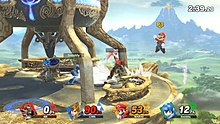
Gameplay in the Super Smash Bros. serial differs from many fighting games.[1] Instead of winning by depleting an opponent's life bar, players seek to launch their opponents off the stage and out of premises. Characters have a damage total which rises as they take damage, represented by a percentage value that measures upwards to 999%. As a graphic symbol's percentage rises, the character tin can be knocked progressively farther past an opponent's attacks.[2] To knock out an opponent, the player must knock that character outside the stage'south boundaries in whatsoever direction.[3] When a graphic symbol is launched off the stage, the character can endeavour to "recover" by using jumping moves and abilities to render to the stage.[2] Some characters have an easier fourth dimension recovering onto the stage than others due to their moves and abilities. Additionally, some characters vary in weight, with lighter characters being easier to launch than heavy characters.[4]
Controls are profoundly simplified in comparing to other fighting games, with one button used for standard attacks and another used for special attacks.[ane] Players can perform unlike types of moves by holding the directional controls up, downwardly, to the side, or in a neutral position while pressing the attack or special button.[2] As such, each character has four types of ground attacks, mid-air attacks, and special attacks that can be performed.[2] Quickly pressing or tapping a directional input and the attack button together while on the basis allows players to perform a chargeable "Smash Attack", which is more often than not more powerful than other attacks.[2] When characters are hit past attacks, they receive a hitstun that temporarily disallows any attacks to be fabricated. This allows combos to be performed. A shield button allows players to put upward a defensive shield which weakens with repeated use and will exit the histrion unable to move if broken. Combining the shield button with directional inputs and attack buttons allows the player to also perform dodges, rolls, grabs, and throws.[v] The three basic actions in Super Smash Bros., attacking, grabbing, and shielding, are ofttimes described using a rock–newspaper–scissors analogy: attacking beats grabbing, grabbing beats shielding, and shielding beats attacking.[6] When a player knocks another player off of the main platform, they may perform an action called edge-guarding.[7] At the same time the player that has been knocked off will effort to recover by jumping back onto the stage and avoiding the other players' edge-guarding.[two]
Another element in the Super Nail Bros. serial is battle items, the affluence of which players can accommodate them before matches. There are conventional "battering items", with which a actor may hit an opponent, such as a home-run bat or a beam sword; throwing items, including Bob-ombs and Koopa shells; and shooting items, either single-shot guns or rapid-fire blasters. Recovery items let the user to reduce their damage pct past varying amounts. Poké Balls are special items that release a random Pokémon onto the battlefield to temporarily help the user. Ball introduced the Assistance Trophy detail which serves a similar purpose; instead of releasing Pokémon, it summons a character from another series.[8] Ball also introduces the Smash Brawl, which when broken allows the fighter to perform a character-specific super set on known as a "Terminal Nail".[8]
The rules that tin can be used in a friction match vary depending on the game, but the 2 most ordinarily used settings beyond all games are Fourth dimension and Stock. Time mode uses a point-based system in which fighters earn points for knocking out their opponents and lose points for being knocked out or self-destructing (i.e. falling out of the stage by themselves). The actor with the highest score at the cease of the set up time limit wins the match. Stock way, also known every bit Survival, uses a life-based organisation in which players are given a ready number of lives, known as stock, with each fighter losing a life whenever they are knocked out, becoming eliminated if they run out of lives. The winner is the concluding fighter standing once all other fighters are eliminated or, if a time limit is applied to the friction match, the fighter with the nearly lives remaining once fourth dimension runs out. In the event of a tie, a Sudden Death match takes place. Here, each of the tied fighters are given a starting damage per centum of 300%, making them easier to launch off the phase, and the terminal fighter standing will be declared equally the winner. In some games this process is repeated if the match ends in another tie.
Gameplay using competitive Super Smash Bros. rules is usually played in Stock way with a timer.[ix] Items are turned off, and the but tournament-legal stages are those that exercise not feature hazards and other disruptive elements.[10]
Games
Super Smash Bros. (1999)
Super Smash Bros. was introduced in 1999 for the Nintendo 64. It was released worldwide after selling over a million copies in Nihon.[11] It featured viii characters from the first (Mario, Donkey Kong, Link, Samus, Yoshi, Kirby, Fob, and Pikachu), with four unlockable characters (Luigi, Helm Falcon, Ness, and Jigglypuff), all of them created past Nintendo or one of its second-political party developers.
In Super Smash Bros., upward to iv players can play in multiplayer (Versus) mode, with the specific rules of each match being predetermined by the players. There are two friction match types that can be chosen: Time, where the person with the near KOs at the cease of the set up time wins; and stock, where each role player has a set number of lives and are eliminated from play when their lives are depleted.
This game's primary single-player fashion, named "Classic Mode" in later series entries, features a series of predetermined opponents the player must defeat. Other single-player modes exist such as Preparation and several minigames, including "Break the Targets" and "Board the Platforms". All of these were included in the sequel, with the exception of "Lath the Platforms".
There are nine playable stages in Versus mode, viii based on each of the starting characters (such as Princess Peach's Castle for Mario, Zebes for Samus, and Sector Z for Fox) and the unlockable Mushroom Kingdom, based around motifs from the original Super Mario Bros., fifty-fifty containing original sprites and the original version of the Overworld theme from that game.
Super Smash Bros. Melee (2001)
A followup for the GameCube, Super Smash Bros. Melee, released in Nihon and North America in late 2001, and in Europe and Commonwealth of australia in May 2002. It had a larger budget and evolution squad than Super Blast Bros. did[12] and was released to much greater praise and acclaim among critics and consumers. Since its release, Super Smash Bros. Melee has sold more vii million copies and was the bestselling game on the GameCube.[13] Super Smash Bros. Melee features 26 characters, of which xv are bachelor initially, more than doubling the number of characters in its predecessor. At that place are also 29 stages.
It introduced two new single-actor modes alongside the Classic mode: Adventure mode and All-Star mode. Adventure mode has platforming segments similar to the original's "Race to the End" mini-game, and All-Star is a fight confronting every playable character in the game, allows the player only one life in which damage is accumulated over each boxing and a limited number of healing items in between battles. As well in Melee is the Habitation-Run Contest minigame, which replaced Board the Platforms in the original game. Hither, fighters volition have to send Sandbag out of the stage to go the best distance with a baseball game bat while damaging it for 10 seconds.
There are also significantly more multiplayer modes and a tournament mode allowing for 64 different competitors whom tin all exist controlled by man players, although but up to 4 players tin can participate at the same time. Additionally, the game featured alternative battle modes, called "Special Melee," which allows players to make many different alterations to the battle, along with culling ways to judge a victory, such as through collecting coins throughout the friction match.[ii]
In place of Super Blast Bros. ' character profiles, Melee introduced trophies (called "figures" in the Japanese version). The 293 trophies include three different profiles for each playable character, i unlocked in each single-player way. In addition, unlike its predecessor, Melee contains profiles for many Nintendo characters who are either non-playable or do non announced in the game, as well every bit Nintendo items, stages, enemies, and elements.
Super Boom Bros. Brawl (2008)
Although a third Super Boom Bros. game had been announced long before E3 2006, Nintendo unveiled its start data in the form of a trailer in 2006, and the game was named Super Smash Bros. Ball and released worldwide in 2008. The game featured a set of tertiary-political party characters, Solid Snake of Konami's Metal Gear series, and longtime Mario rival Sonic the Hedgehog from Sega's series of the aforementioned name. Ball was besides the commencement game in the franchise to support online play, via the Nintendo Wi-Fi Connexion,[14] and to offer the ability for players to construct their ain original stages.[15] The game features a total of 39 playable characters and 41 stages.
Brawl also features compatibility with four kinds of controllers (the Wii Remote on its side, the Wii Remote and Nunchuk combination, the Archetype Controller, and the GameCube controller),[sixteen] while its predecessors only used the one controller designed for that system. The role player as well has the ability to change the configuration of controls and the controller blazon.[17]
Super Smash Bros. Brawl features a single-histrion mode known as The Subspace Emissary. This manner features unique grapheme storylines forth with numerous side-scrolling levels and multiple bosses to fight, as well as CG cutting scenes explaining the storyline. The Subspace Emissary features a new group of antagonists chosen the Subspace Army, who are led by the Ancient Government minister. Some of these enemy characters appeared in previous Nintendo video games, such as Petey Piranha from the Super Mario series and a squadron of R.O.B.s based on classic Nintendo hardware. The Subspace Emissary likewise boasts a number of original enemies, such as the Roader, a robotic unicycle; the Bytan, a one-eyed ball-like animal which can replicate itself if left alone; and the Primid, enemies that come up in many variations.[18] Though primarily a single-player way, The Subspace Emissary allows for cooperative multiplayer. There are five difficulty levels for each phase, and at that place is a method of increasing characters' powers during the game.[19] This is done by placing collected stickers onto the bottom of a character'due south trophy between stages to improve various aspects of a fighter.[twenty]
Super Smash Bros. for Nintendo 3DS and Wii U (2014)
At E3 2011, information technology was confirmed that a fourth Super Smash Bros. game would exist coming to the Nintendo 3DS and Wii U, with the two games being cross-compatible with each other.[21] [22] [23] Sakurai stated that the announcement was fabricated public in society to attract developers needed for the games, as evolution for the games did not start until May 2012 due to production on Kid Icarus: Insurgence.[24] [25] On June 21, 2012, Nintendo appear that the cosmos of the games would be a co-product between Sakurai's Sora Ltd. and Bandai Namco Entertainment.[26] The games were officially revealed at E3 2013, with new information being released via trailers, Nintendo Directly presentations, and developer posts on Miiverse.[27] The game features 58 characters,[28] 19 of whom are new, and 7 of whom are downloadable. The game was released for Nintendo 3DS in Japan in September 2014, and in North America, Europe, and Australia the following calendar month. The Wii U version was released in North America, Europe, and Australia in November 2014, and in Japan the post-obit month.[29] [30] [31]
Super Smash Bros. Ultimate (2018)
In April 2014, Bandai Namco Entertainment posted a recruitment advertizing on a Japanese career chore opportunity website. The recruitment folio consisted of a listing for programmers for "Smash Bros. 6", which was expected to exist released in 2015 for both the Wii U and Nintendo 3DS. The folio noted there were 120 game developers working on the projection at the fourth dimension, and that Bandai Namco expected that number to increase to 200. However, shortly later on its publication, the folio was taken down.[32] In a January 2015 column in Weekly Famitsu, Sakurai alluded to the possibility of retirement, expressing doubtfulness that he would be able to go along making games if his career continued to exist every bit stressful as information technology was.[33] In Dec 2015, Sakurai once again stated that he was non sure if at that place would be another game in the Nail Bros. series.[34]
On March 8, 2018, a teaser for the game was shown during a Nintendo Directly.[35] [36] [37] Sakurai after confirmed that he had worked on the game "in silence, day after solar day."[38] [39] On March 22, 2018, Nintendo appear that they would host another Super Smash Bros. Invitational tournament, in which a selected group of players would get to play the game for the commencement time and compete in a serial of matches before a winner is chosen. The tournament took place alongside the Splatoon 2 Globe Championship at E3 2018 and was held on June 11–12. Both events were live streamed on Nintendo's official YouTube and Twitch channels.[40] The title was confirmed as Super Blast Bros. Ultimate at E3 2018, where it was also appear that it would contain all playable characters from every previous game.[41]
The game was released worldwide on December 7, 2018; co-ordinate to the review aggregator platform Metacritic, it received "universal critical acclamation" from critics and scored 93 out of 100.[42] In addition to all returning characters, the base game release adds 11 newcomers. 13 additional new characters are also available via downloadable content.[43]
Like Brawl, Ultimate features a story fashion, known every bit World of Calorie-free. The plot revolves around the devastation of the Nail Bros. world at the hands of original villain Galeem. Initially only able to play equally Kirby, who survived the attack, the actor travels across the wasteland to rescue the other playable fighters, gathering "Spirits" (the remnants of the world'south non-playable characters who aid the thespian in boxing) along the style.
Characters
Each game in the series has a number of playable characters (referred in the games as "fighters") taken from various gaming franchises, with 83 full beyond the serial. Starting with Super Smash Bros. Brawl, characters from non-Nintendo franchises began to make playable appearances. In Super Blast Bros. for Nintendo 3DS and Wii U, players were able to customize existing fighters with altered movesets and abilities, likewise as making their own Mii fighters that tin be given three different fighting styles. At that place are also other not-playable characters that take the form of enemies, bosses, and summonable power-up items.
Evolution

The Super Nail Bros. emblem, which usually appears every bit the "O" in the full logo. The cross represents the idea of crossovers, with the iv sectors representing the iv-histrion fighting way.
Super Smash Bros. was developed by HAL Laboratory, an independent chapter company, during 1998. It began every bit a epitome created by Masahiro Sakurai and Satoru Iwata in their spare time, Dragon Male monarch: The Fighting Game, and featured no Nintendo characters. However, Sakurai striking on the idea of including fighters from different Nintendo franchises in order to provide "atmosphere" which he felt was necessary for a dwelling house panel fighting game, and his idea was approved.[44] Although never acknowledged by Nintendo or any developers behind Super Smash Bros., third-political party sources have identified Namco'south 1995 fighting game The Outfoxies as a possible inspiration.[45] [46] [47] The game had a minor budget and little promotion, and was originally a Japan-only release, but its huge success saw the game released worldwide.[48]
HAL Laboratory developed Super Blast Bros. Melee, with Masahiro Sakurai as the head of production. The game was one of the first games released on the GameCube and highlighted the advancement in graphics from the Nintendo 64. The developers wanted to pay homage to the debut of the GameCube by making an opening full motion video sequence that would concenter people's attending to the graphics.[49] HAL worked with iii carve up graphic houses in Tokyo to make the opening sequence. On their official website, the developers posted screenshots and information highlighting and explaining the attention to physics and detail in the game, with references to changes from its predecessor.[fifty] The Super Smash Bros. logo, consisting of two lines of different weight crossing within a circumvolve, represented the idea of a franchise crossover, co-ordinate to Sakurai, naturally dividing the circle into four sections to represent the 4-player fighting mode.[51]
At a pre-E3 2005 press conference, president of Nintendo at the time Satoru Iwata appear the next installment of Super Smash Bros. was not just already in development for their next gaming panel, but hoped it would exist a launch game with Wi–Fi compatibility for online play.[52] The announcement was unexpected to the creator of the Super Smash Bros. series, Masahiro Sakurai. Dorsum in 2003, he had left HAL Laboratory, the visitor that was in charge with the franchises' evolution and was never informed of this proclamation despite the fact shortly later on resigning from the company, Iwata said if a new game was to be made, he would be in charge. It was non until afterwards the conference Sakurai was called to Satoru Iwata's room on the top floor of a Los Angeles hotel, where he was told by Iwata "We'd like y'all to be involved in the product of the new Nail Bros., if possible nigh the level of director".[53] Although Iwata had said he was hoping for information technology to be a launch game, Sakurai stated: "I decided to become manager. And every bit of May 2005, I was the only member of the new Smash Bros. evolution team." Evolution of the game never actually started until October 2005,[54] when Nintendo opened a new function in Tokyo just for its production. Nintendo also enlisted outside aid from various developer studios, mainly Game Arts. Sakurai likewise stated that these people had spent excessive amounts of time playing Super Smash Bros. Melee. This squad was given access to all the original material and tools from the development of Melee, courtesy of HAL Laboratory. Besides, several Nail Bros. staff members that reside effectually the surface area of the new office joined the projection'due south development.[55] [56]
On the game'southward official Japanese website, the developers explicate reasons for making item characters playable and explain why some characters were not available as playable characters upon release. Initially, the development team wanted to replace Ness with Lucas, the main character of Mother 3 for the Game Male child Advance, but they retained Ness in consideration of delays.[57] The game's creators have included Lucas in the game'southward sequel, Super Smash Bros. Ball.[58] [59] Video game developer Hideo Kojima originally requested Solid Snake, the protagonist of the Metal Gear series, to be a playable character in Super Boom Bros. Melee, simply the game was likewise far in development for him to be included. As with Lucas, evolution time immune for his inclusion in Brawl. Roy and Marth were initially intended to be playable exclusively in the Japanese version of Super Nail Bros. Melee. However, they received favorable attention during the game's Northward American localization, leading to the determination for the developers to include them in the Western version. Comparisons accept been formed by the developers between characters which accept very similar moves to each other on the website. Such characters were referred to as "clones" in the media.
At the Nintendo Media Conference at E3 2007, it was announced by Nintendo of America president Reggie Fils-Aimé that Super Blast Bros. Brawl would exist released on December iii, 2007, in the Americas. However, just 2 months before its anticipated December release, the evolution squad asked for more than time to work on the game. During the Nintendo Conference on October x, 2007, Nintendo Co., Ltd. president Iwata announced the delay.
On October 11, 2007, George Harrison of Nintendo of America announced that Super Smash Bros. Brawl would be released on February ten, 2008, in Due north America.[60] On January 15, 2008, the game's release was pushed dorsum one week in Japan to January 31 and nearly a month in the Americas to March 9.[61] On Apr 24, 2008, it was confirmed by Nintendo of Europe that Ball will be released in Europe on June 27.[62]
Manager Masahiro Sakurai first announced that a new Super Smash Bros. game was planned for Nintendo 3DS and Wii U at E3 2011 in June 2011, simply development just officially began following the completion of Sakurai's other project, Child Icarus: Insurgence, in March 2012.[63] [64] The game was later revealed to exist a joint-project between Sora Ltd. and Bandai Namco Games, with various staff members from Bandai Namco's Soulcalibur and Tekken series assisting Sakurai in evolution.[65] [66] [67] Sakurai, who was previously the sole person responsible for balance in the series' multiple fighters, has involved more staff to further improve the game's competitive balance.[68] The game was officially revealed at E3 2013 on June eleven, 2013, during a Nintendo Direct presentation.[69] Along with screenshots being posted each weekday on the game's official website and Miiverse community,[70] diverse cinematic trailers were released, introducing each of the brand new fighters. Sakurai chose to use these trailers, which benefit from Internet sharing, as opposed to including a story campaign similar to the Subspace Emissary fashion featured in Brawl, equally he believed the touch of seeing the fashion's cinematic cutscenes for the first time was ruined past people uploading said scenes to video sharing websites.[71] [72]
At E3 2013, Sakurai stated that the tripping mechanic introduced in Brawl was removed, with him also stating that the gameplay was betwixt the fast-paced and competitive style of Melee and the slower and more casual manner of Brawl.[73] While the games didn't feature cross-platform play between the Wii U and 3DS, due to each version featuring certain exclusive stages and gamemodes, in that location is an option to transfer customized characters and items between the two versions.[74] The game builds upon the previous game'southward tertiary-party interest with the addition of third-party characters such as Capcom'south Mega Human being and Bandai Namco's Pac-Homo, also as the return of Sega'south Sonic the Hedgehog. This involvement expands beyond playable characters, as other 3rd-party characters, such as Ubisoft'due south Rayman, are as well included in the game as trophies.[75] The addition of Mii characters was made in response to the growing number of requests from fans to have their dream characters included in the game. To prevent potential bullying, too as to maintain game rest online, Mii Fighters cannot be used in online matches confronting strangers.[76] The decision to release the Wii U version at a later date from the 3DS version was made to allow each version to receive a defended debugging menstruation.[77] Hardware limitations on the Nintendo 3DS led to diverse design choices, such as the removal of mid-match transformations, the absence of the Ice Climbers, and the lack of Circumvolve Pad Pro support.[78]
Music
Super Smash Bros. features music from some of Nintendo's popular gaming franchises. While many are newly bundled for the game, some songs are taken directly from their sources. The music for the Nintendo 64 game was composed by Hirokazu Ando, who later returned as sound and music managing director in Melee. Melee also features tracks composed by Tadashi Ikegami, Shougo Sakai, and Takuto Kitsuta.[79] Brawl featured the collaboration of 38 contracted composers,[80] including Final Fantasy series composer Nobuo Uematsu, who composed the master theme.[81] Like in Brawl, Super Blast Bros. for Nintendo 3DS and Wii U featured many original and re-arranged tracks from various different gaming franchises from a variety of different composers and arrangers. Both versions have multiple musical tracks that tin can be selected and listened to using the returning "My Music" feature, including pieces taken straight from earlier Super Smash Bros. games. The 3DS and Switch games allow players to listen to their music from the audio carte du jour while the arrangement is in sleep/handheld way.[82] [83] Ultimate connected the trend of multiple composers and arrangers working on remixed tracks, having over 800 in total.[83] [84]
Three soundtrack albums for the series accept been released. An album with the original music for Super Smash Bros. was released in Japan by Teichiku Records in 2000.[85] In 2003, Nintendo released Cracking...Live!, a alive orchestrated performance of various pieces featured in Melee by the New Japan Combo.[86] A two-disc promotional soundtrack titled A Smashing Soundtrack was available for Club Nintendo members who registered both the 3DS and Wii U games between November 21, 2014, and Jan 13, 2015.[87]
Reception
![[icon]](https://upload.wikimedia.org/wikipedia/commons/thumb/1/1c/Wiki_letter_w_cropped.svg/20px-Wiki_letter_w_cropped.svg.png) | This department needs expansion with: prose reception virtually Ultimate. You can assist by adding to it. (February 2021) |
Reviews for the Super Smash Bros. series are normally positive. The multiplayer style in every game is unremarkably highly praised; still, single-player modes have not always been viewed every bit highly.
Super Smash Bros. received praise for its multiplayer mode. Nintendo Ability listed the serial as being ane of the greatest multiplayer experiences in Nintendo history, describing it every bit infinitely replayable due to its special moves and close-quarters combat.[99] There were criticisms, yet, such every bit the game's scoring being difficult to follow.[100] In addition, the single-player mode was criticized for its perceived difficulty and lack of features.
Super Nail Bros. Melee by and large received a positive reception from reviewers, most of whom credited Melee 'southward expansion of gameplay features from Super Smash Bros. Focusing on the additional features, GameSpy commented that "Melee really scores big in the 'we've added tons of great actress stuff' department." Reviewers compared the game favorably to Super Blast Bros.—IGN's Fran Mirabella Iii stated that it was "in an entirely different league than the N64 version"; GameSpot's Miguel Lopez praised the game for offering an advanced "classic-mode" compared to its predecessor, while detailing the Risk Mode as "really a striking-or-miss experience." Despite a mixed response to the unmarried-player modes, most reviewers expressed the game'south multiplayer mode every bit a stiff component of the game. In their review of the game, GameSpy stated that "you lot'll have a pretty hard time finding a more enjoyable multiplayer feel on any other panel."
Brawl received a perfect score from the Japanese magazine Famitsu. The reviewers praised the variety and depth of the single-thespian content,[101] the unpredictability of Concluding Smashes, and the dynamic fighting styles of the characters. Thunderbolt Games gave the game x out of 10, calling it "a vastly improved entry into the venerable serial". Chris Slate of Nintendo Power also awarded Brawl a perfect score in its March 2008 consequence, calling information technology "one of the very best games that Nintendo has ever produced". IGN critic Matt Casamassina, in his Feb 11 Wii-k in Review podcast, noted that although Brawl is a "solid fighter," it does have "some issues that need to be best-selling," including "long loading times" and repetition in The Subspace Emissary.
Super Nail Bros. for 3DS and Super Blast Bros. for Wii U both garnered critical praise and were commercially successful, holding electric current ratings of 85/100 and 92/100 on Metacritic and 86.10% and 92.39% on GameRankings.[102] [94] [103] [104] Reviewers take peculiarly noted the large, diverse character roster, the improvements to game mechanics, and the variety of multiplayer options. Some criticisms in the 3DS version include a lack of single-player modes and issues concerning the 3DS hardware, such as the size of characters on the smaller screen when zoomed out and latency issues during both local and online multiplayer.[105] [106] There were as well reports of players damaging their 3DS Circle Pads while playing the game excessively.[107] [108] The Wii U version'southward online play quality was mildly criticized for some inconsistency, simply has overall been critically acclaimed. Daniel Dischoff of Game Revolution stated "Information technology's truthful that Super Smash Bros. evolves every fourth dimension with regard to new features, items, and characters to choose from. While your favorite character may not return or a few abrasive pickups may force y'all to turn off items altogether, this represents the biggest leap forward Smashers accept seen yet." Daniel Starky at GameSpot criticized the inconsistent online performance in the game, but however called it an "incredible game", noting "With the Wii U release, Nail Bros. has fully realized its goals." Jose Otero from IGN, praising the replayability of the game, states "Virtually every aspect of Smash Wii U seems fine-tuned not only to entreatment to the nostalgia of long-time Nintendo fans, but too to be accessible to new players."
Sales
Super Smash Bros. sold i.4 million copies in Japan,[109] and 2.iii one thousand thousand in the U.S.,[110] with a total of 5.55 million units worldwide.[88] Melee sold over 7 1000000 units worldwide, becoming the acknowledged GameCube game.[13] Brawl sold i.524 one thousand thousand units in Nihon as of March 30, 2008[update],[111] and sold 1.4 million units in its first week in the United States, becoming Nintendo of America's fastest selling game.[112] The 3DS version sold over a million copies in its first weekend on sale in Nippon,[113] and has sold more than than 9.63 1000000 copies worldwide equally of September 2021[update].[93] Super Boom Bros. for Wii U became the fastest-selling Wii U game to engagement, selling iii.39 million units worldwide within but ii months of availability, beating the record previously held by Mario Kart viii.[114] Equally of September 2021, it has sold 5.38 million copies worldwide.[95] Super Blast Bros. Ultimate on Nintendo Switch has set new record highs for the series and for the system.[115] [116] It sold an estimate of 5.6 one thousand thousand copies in global sales during its first week of launch, beating out records previously held past games such as Pokémon: Let'due south Go, Pikachu! and Let's Go, Eevee!, Super Mario Odyssey, and The Legend of Zelda: Breath of the Wild.[117] In Japan, Ultimate outsold the records held by Super Blast Bros. for Nintendo 3DS with 2.6 one thousand thousand copies sold in five weeks.[118] Information technology is also the third best-selling game for the Nintendo Switch and the all-time-selling fighting game of all time, with 27.40 million copies sold worldwide as of Dec 31, 2021.[97]
Esports
The Super Smash Bros. series has been widely played as a competitive video game, with several of the games in the serial having been featured in high-profile tournaments, including Major League Gaming (MLG) and Evolution Title Serial (EVO), amidst others.[119] The first publicized professional Smash Bros. tournaments were held for Super Smash Bros. Melee in early 2002.[120] Current major Boom Bros. annual tournament series include GENESIS, EVO, Super Blast Con and The Big House. The competitive Blast Bros. community is well known amongst the wider fighting game community for its decentralized, grassroots scene, a byproduct of Nintendo's historical reluctance to directly promote the scene.[121] [122]
Notes
- ^ Known in Nippon equally Dai Rantō Smash Brothers (Japanese: 大乱闘スマッシュブラザーズ, Hepburn: Dai Rantō Sumasshu Burazāzu , lit. "Large Brawl Boom Brothers").
References
- ^ a b Schneider, Peer (April 27, 1999). "Super Smash Bros. N64 Review". IGN. Archived from the original on December 27, 2012. Retrieved January 30, 2015.
- ^ a b c d eastward f g Super Blast Bros. Melee Didactics Booklet. 2001.
- ^ "The Basic Rules". Blast Bros. DOJO!!. Smashbros.com. Archived from the original on July 3, 2013. Retrieved April 15, 2008.
- ^ "Y'all Must Recover!". Smash Bros. DOJO!!. Smashbros.com. Archived from the original on July three, 2013. Retrieved April 15, 2008.
- ^ Schneider, Peer (April 27, 1999). "Super Blast Bros. review". IGN. Archived from the original on May 12, 2008. Retrieved April sixteen, 2008.
- ^ LeJacq, Yannick (December 22, 2015). "What Pros Take To Call up About In Every Smash Bros. Friction match". Kotaku. Archived from the original on January 31, 2015. Retrieved January thirty, 2015.
- ^ Otero, Jose (January 22, 2014). "Smash Bros. Will Change The Way Edge-Guarding Works". IGN. Archived from the original on January 31, 2015. Retrieved January 30, 2015.
- ^ a b Super Boom Bros. Brawl Educational activity Booklet (PDF). Nintendo. 2008. Archived (PDF) from the original on September 15, 2016.
- ^ "EVO 2013 Rules". IGN. Archived from the original on Feb 1, 2015. Retrieved January thirty, 2015.
- ^ Dawson, Bryan (September 11, 2014). "How to get into Competitive Super Nail Bros". Prima Games. Archived from the original on Jan 31, 2015. Retrieved January 30, 2015.
- ^ "Nifty Success: Nintendo'south Super Boom Bros. continues to tiptop the charts in Japan". IGN. October 28, 1999. Archived from the original on May 1, 2018. Retrieved August 5, 2007.
- ^ "Super Smash Bros. Melee". Archived from the original on January 23, 2008. Retrieved Apr 21, 2008.
- ^ a b c "At Long Concluding, Nintendo Proclaims: Let the Brawls Begin on Wii!". Nintendo. March x, 2008. Archived from the original on May 13, 2008. Retrieved March 15, 2008.
- ^ "Wi-Fi Play". Smash Bros. DOJO!!. Smashbros.com. September 18, 2007. Archived from the original on Baronial 11, 2013. Retrieved September 18, 2007.
- ^ "Phase Builder". Smash Bros. DOJO!!. Smashbros.com. Feb 27, 2008. Archived from the original on July 5, 2013. Retrieved Feb 27, 2008.
- ^ "Four Kinds of Control". Smash Bros. DOJO!!. Smashbros.com. Archived from the original on July v, 2013. Retrieved April 15, 2008.
- ^ "Names". Blast Bros. DOJO!!. Smashbros.com. Archived from the original on July v, 2013.
- ^ "The Enemies From Subspace". Nail Bros. DOJO!!. Smashbros.com. September nineteen, 2007. Archived from the original on October 19, 2013. Retrieved September 19, 2007.
- ^ "Squad". Blast Bros. DOJO!!. Smashbros.com. October five, 2007. Archived from the original on October 19, 2013. Retrieved October five, 2007.
- ^ "Sticker Power-ups". Smash Bros. DOJO!!. Smashbros.com. Archived from the original on October 19, 2013. Retrieved January 18, 2008.
- ^ Schreier, Jason. "An In-Depth Conversation With The Genius Behind Super Smash Bros". Kotaku. Gawker Media. Archived from the original on April 27, 2015.
- ^ Tanner, Nicole (June seven, 2011). "E3 2011: Smash Bros. Coming to 3DS and Wii U". IGN. Archived from the original on June 10, 2011.
- ^ Heart, Adam (June nine, 2011). "Smash Brothers Next and Guest Characters". Shoryuken. Archived from the original on June 12, 2011. Retrieved June ten, 2011.
This game will exist for both the Wii U and the 3DS, and will accept some connectivity between the ii versions.
- ^ Ashcraft, Brian. "Cold Water Thrown on Smash Bros. for Wii U and 3DS". Kotaku. Archived from the original on June 11, 2011.
- ^ "Nail Bros. Wii U/3DS very early on in evolution, said it shouldn't have been announced". GoNintendo. Archived from the original on June xi, 2011.
- ^ Drake, Audrey. "Namco Bandai Developing Adjacent Smash Bros". IGN. Archived from the original on May 17, 2013.
- ^ Goldfarb, Andrew (January 23, 2013). "Smash Bros, Mario, Mario Kart Confirmed for E3 2013". IGN. Archived from the original on March eleven, 2013. Retrieved Jan 23, 2013.
- ^ "Super Smash Bros. for Nintendo 3DS and Wii U - Final Video Presentation". Nintendo. December 15, 2015. Archived from the original on January x, 2016. Retrieved Dec 15, 2015.
- ^ Karmali, Luke. "Super Boom Bros. on Wii U Gets Release Date". IGN. Archived from the original on October 8, 2014. Retrieved October 7, 2014.
- ^ "『大乱闘スマッシュブラザーズ』"Miiファイター"参戦決定、『for Nintendo 3DS』発売日も決定!【E3 2014】" (in Japanese). Famitsu. June 11, 2014. Archived from the original on June 14, 2014. Retrieved June eleven, 2014.
- ^ Dyer, Mitch (June 10, 2014). "E3 2014: Super Smash Bros. for 3DS Delayed". IGN. Archived from the original on June 13, 2014. Retrieved June 10, 2014.
- ^ "Report: Bandai Namco Recruiting For A Smash Bros. Game Coming In 2015". Siliconera. Curse. Archived from the original on July thirteen, 2014. Retrieved July 15, 2014.
- ^ Nakamura, Toshi (Jan 29, 2015). "Smash Bros. Could be its Creator's Concluding Game". Kotaku. Archived from the original on January thirty, 2015. Retrieved January 30, 2015.
- ^ Makuch, Eddie. "Super Boom Bros. Wii U/3DS DLC Ending Soon Director Says". GameSpot. Archived from the original on December sixteen, 2015. Retrieved December 14, 2015.
- ^ "Super Blast Bros. announced for Nintendo Switch". Eurogamer. March viii, 2018. Archived from the original on May 1, 2018. Retrieved May 1, 2018.
- ^ McWhertor, Michael (March 8, 2018). "Super Smash Bros. is coming to Nintendo Switch". Polygon. Archived from the original on March 9, 2018. Retrieved March eight, 2018.
- ^ "The Super Smash Bros. series heads to Nintendo Switch in 2018". Nintendo.com. March 8, 2018. Archived from the original on March 9, 2018. Retrieved March 8, 2018.
- ^ "Super Smash Bros. director says he's returning for Switch sequel". Polygon. March nine, 2018. Archived from the original on May 1, 2018. Retrieved May ane, 2018.
- ^ "Series Creator Mashiro Sakurai Confirmed To Exist Working On Super Nail Bros. For Switch". Siliconera. March 9, 2018. Archived from the original on May 1, 2018. Retrieved March 9, 2018.
- ^ Stark, Chelsea (March 22, 2018). "Official Super Smash Bros. for Switch, Splatoon two tournaments coming to E3". Polygon. Archived from the original on March 23, 2018. Retrieved March 23, 2018.
- ^ Tran, Edmond (June 12, 2018). "E3 2018: Super Smash Bros. Ultimate For Switch Volition Have Every Previous Fighter". GameSpot . Retrieved June 12, 2018.
- ^ "Super Smash Bros. Ultimate". Metacritic . Retrieved December eight, 2018.
- ^ Craddock, Ryan (July eight, 2021). "Sakurai Reminds Us At that place's Only One DLC Fighter Left For Blast Ultimate (Over again)". Nintendo Life . Retrieved September half dozen, 2021.
- ^ "Wii.com — Iwata Asks: Super Smash Bros. Brawl". Nintendo.com. Archived from the original on April 9, 2008. Retrieved Jan 31, 2008.
- ^ Burns, Ed (November 22, 2012). "The Outfoxies". Hardcore Gaming 101. Archived from the original on April 22, 2018.
- ^ Holmes, Jonathan (March iii, 2008). "Half-dozen Days to Nail Bros. Brawl: Top Five Nail Bros alternatives". Destructoid. Archived from the original on March four, 2016.
- ^ Sullivan, Lucas (September 19, 2014). "fifteen Smash Bros. rip-offs that couldn't outdo Nintendo". GamesRadar+. Archived from the original on November 15, 2017.
- ^ "Super Nail Bros. Melee". north-Sider. Archived from the original on January 23, 2008.
- ^ "Smash Bros. FMV Explained". IGN. August 31, 2001. Archived from the original on December 7, 2008. Retrieved November 24, 2007.
- ^ "A Detailed Melee". IGN. September seven, 2001. Archived from the original on March 28, 2008. Retrieved November 24, 2007.
- ^ Santangelo, Nick (December fourteen, 2018). "Masahiro Sakurai Explains What The Super Smash Bros. Logo Symbolizes". IGN . Retrieved December fourteen, 2018.
- ^ Casamassina, Matt (May 17, 2005). "E3 2005: Smash Bros. For Revolution". IGN. Archived from the original on June 15, 2006. Retrieved May three, 2006.
- ^ IGN Staff (Nov sixteen, 2005). "Smash Bros. Revolution Director Revealed". IGN. Archived from the original on August twenty, 2007. Retrieved June 21, 2007.
- ^ Sakurai, Masahiro. "Foreword". Smashbros.com. Archived from the original on November 16, 2006. Retrieved November xi, 2007.
- ^ Gantayat, Anoop (December 5, 2005). "Sakurai Elaborates on Blast Bros. Revolution". IGN. Archived from the original on July four, 2007. Retrieved June 21, 2007.
- ^ Sakurai, Masahiro. "Masahiro Sakurai's Thoughts Near Games". Famitsu. Smashbros.com. pp. 1, 3, 4. Archived from the original on July 17, 2006. Retrieved September 12, 2007.
- ^ Sakurai, Masahiro (July 17, 2001). "Super Smash Bros. Melee". Archived from the original on July 7, 2014. Retrieved Nov 24, 2007.
- ^ Sakurai, Masahiro (Oct 1, 2007). "Super Smash Bros. Brawl—Lucas". Archived from the original on July 5, 2013. Retrieved November 24, 2007.
- ^ Sakurai, Masahiro (September 21, 2001). "Super Smash Bros. Brawl—Snake". Archived from the original on July 5, 2013. Retrieved November 24, 2007.
- ^ "Smash Release Date Confirmed". Archived from the original on Oct 12, 2007. Retrieved October 14, 2007.
- ^ Casamassina, Matt (January 14, 2008). "Breaking: Blast Bros. Delayed". IGN. Archived from the original on January xviii, 2008. Retrieved Jan twenty, 2008.
- ^ "Nintendo announces Q2 release schedule". Nintendo. Apr 24, 2008. Archived from the original on May 30, 2012. Retrieved April 24, 2008.
- ^ Gantayat, Anoop (September 21, 2011). "Sakurai: No Progress on New Nail Bros. Until Kid Icarus is Consummate". Andriasang. Archived from the original on September 23, 2011. Retrieved September 22, 2011.
- ^ Gantayat, Anoop (June 8, 2012). "Smash Bros. U & 3DS evolution appears to be very early". Andriasang. Archived from the original on October 25, 2012. Retrieved June 9, 2012.
- ^ O'Brien, Lucy (July ten, 2012). "Kid Icarus: Uprising Developer Closes". IGN. Archived from the original on July 15, 2012. Retrieved July 11, 2012.
- ^ Barnett, Patrick. "Sakurai and Kobayashi Release Letters Regarding Blast Bros". nintendoworldreport.com. Archived from the original on July 28, 2014. Retrieved July 20, 2014.
- ^ Drake, Audrey (June 21, 2012). "Namco Bandai Developing Adjacent Nail Bros". IGN. Archived from the original on June 25, 2012. Retrieved June 21, 2012.
- ^ George, Richard (June 8, 2011). "E3 2011: Early Super Smash Bros Details Revealed". IGN. Archived from the original on September 17, 2012. Retrieved July 18, 2011.
- ^ George, Richard (June xi, 2013). "E3 2013: Mega Man Joins Super Nail Bros". IGN. Archived from the original on July xiii, 2015. Retrieved June 11, 2013.
- ^ "Miiverse | Nintendo". Miiverse.nintendo.cyberspace. Archived from the original on April 3, 2015. Retrieved April 9, 2014.
- ^ "New Super Smash Bros. removes tripping; game speed between Brawl and Melee". Polygon. June 14, 2013. Archived from the original on July xix, 2013. Retrieved July 25, 2013.
- ^ "The Adjacent Super Smash Bros. Won't Have a Story Mode and Cutscenes". Kotaku.com. July 25, 2013. Archived from the original on July 25, 2013. Retrieved July 25, 2013.
- ^ "E3 2013: No Plans for Smash Bros. DLC, Tripping Removed". IGN. May 31, 2013. Archived from the original on June 13, 2013. Retrieved June 13, 2013.
- ^ Mitchell, Richard (June 13, 2013). "No cross-platform play for Blast Bros on 3DS and Wii U". Joystiq.com. AOL Tech. Archived from the original on June 16, 2013. Retrieved June 13, 2013.
- ^ "Miiverse - Sakurai's post - Nintendo". Miiverse - Nintendo. Archived from the original on October 11, 2014. Retrieved October 17, 2014.
- ^ Corriea, Alexa Ray (June xix, 2014). "Mii Fighters were added to Super Boom Bros due to growing presence and fan requests". Polygon. Archived from the original on June 21, 2014. Retrieved June nineteen, 2014.
- ^ Nakamura, Toshi (August 21, 2014). "Blast Bros. Creator Explains Why Wii U Owners Have to Wait". Kotaku. Archived from the original on August 21, 2014. Retrieved August 22, 2014.
- ^ "Why Zelda and Sheik Are Dissimilar Characters In Super Blast Bros. For 3DS". Siliconera. Archived from the original on October 8, 2014. Retrieved October 13, 2014.
- ^ "Discussions music staff" (in Japanese). Nintendo. January 18, 2002. Retrieved January ten, 2008.
- ^ "The Musicians". Boom Bros Dojo!!. May 22, 2007. Archived from the original on July 6, 2013. Retrieved April 15, 2008.
- ^ "Super Smash Bros. Brawl: Main Theme". Smash Bros Dojo!!. September 7, 2007. Archived from the original on August 8, 2013. Retrieved Apr 15, 2008.
- ^ "Super Smash Bros. For 3DS Lets You Heed To Music In Sleep Mode". Siliconera. Archived from the original on August 26, 2014. Retrieved Baronial 22, 2014.
- ^ a b Hussain, Tamoor. "Super Blast Bros. Ultimate Soundtrack Has Over 800 Songs". GameSpot . Retrieved September nineteen, 2018.
- ^ "Music". Super Nail Bros. Ultimate - Nintendo . Retrieved June 12, 2020.
- ^ "Nintendo All-Star! Dairanto Smash Brothers Original Soundtrack". Soundtrack Cardinal. January 17, 2002. Archived from the original on Oct 11, 2008. Retrieved April xvi, 2008.
- ^ Wachman, Dylan (Baronial 21, 2005). "Slap-up...Alive! Review". Sputnik Music. Retrieved March xv, 2008.
- ^ "Super Smash Bros. Soundtrack Offer". Club Nintendo. Archived from the original on October 12, 2014. Retrieved October 12, 2014.
- ^ a b Hansen, Steven (October 26, 2016). "More like Mario Kart 8 million: Here are the Wii U and 3DS best-sellers". Destructoid. Destructoid. Archived from the original on April 25, 2017. Retrieved April 26, 2018.
- ^ "Super Smash Bros. for Nintendo 64 Reviews". Metacritic. CBS Interactive. Archived from the original on July 12, 2014. Retrieved January 2, 2019.
- ^ "Super Smash Bros. Melee for GameCube Reviews". Metacritic. CBS Interactive. Archived from the original on September 26, 2014. Retrieved Jan 2, 2019.
- ^ "Elevation Selling Software Sales Units". Nintendo. March 31, 2018. Archived from the original on December 19, 2017. Retrieved April 26, 2018.
- ^ "Super Smash Bros. Brawl for Wii Reviews". Metacritic. CBS Interactive. Archived from the original on August 19, 2010. Retrieved January two, 2019.
- ^ a b "Superlative Selling Title Sales Units (Nintendo 3DS)". Nintendo. Nintendo, Co. Ltd. Archived from the original on Oct 31, 2017. Retrieved November 24, 2021.
- ^ a b "Super Nail Bros. for Nintendo 3DS for 3DS Reviews". Metacritic. CBS Interactive. Oct two, 2014. Archived from the original on Nov 28, 2015. Retrieved January two, 2019.
- ^ a b "IR Data : Financial Data - Meridian Selling Championship Sales Units - Wii U Software". Nintendo. Nintendo, Co. Ltd. Archived from the original on Oct 31, 2017. Retrieved Nov 21, 2021.
- ^ "Super Blast Bros. for Wii U for Wii U Reviews". Metacritic. CBS Interactive. Archived from the original on November ten, 2015. Retrieved January 2, 2019.
- ^ a b "Peak Selling Title Units". Nintendo. December 31, 2021. Retrieved February three, 2022.
- ^ "Super Smash Bros. Ultimate for Switch Reviews". Metacritic. CBS Interactive. Retrieved January 17, 2019.
- ^ Nintendo Power 250th outcome!. South San Francisco, California: Future US. 2010. p. 47.
- ^ "Game Critics Review". gamecritics.com. Archived from the original on February 25, 2012.
- ^ "Perfect Score for Blast Bros". IGN. Jan 16, 2008. Archived from the original on January 19, 2008. Retrieved January 29, 2008.
- ^ "Super Blast Bros. for Nintendo 3DS for 3DS". GameRankings. CBS Interactive. October 2, 2014. Archived from the original on November 15, 2015.
- ^ "Super Smash Bros. for Wii U for Wii U". GameRankings. CBS Interactive. Archived from the original on November 2, 2015.
- ^ "Super Boom Bros. for Wii U for Wii U Reviews". Metacritic. CBS Interactive. Archived from the original on Nov 10, 2015.
- ^ "Super Smash Bros. 3DS review". GamesRadar. Archived from the original on September 27, 2014. Retrieved September 26, 2014.
- ^ "Super Smash Bros. for 3DS review (JP version)". September 17, 2014. Archived from the original on September xiii, 2014. Retrieved September 19, 2014.
- ^ Hernandez, Patricia. "24 Hours in, Playing Smash Bros. on My 3DS is Wrecking My Circlepad". Kotaku. Archived from the original on Oct 11, 2014. Retrieved October 12, 2014.
- ^ Ashcraft, Brian. "Super Smash Bros. is Wrecking Some People'south 3DS Handhelds". Kotaku. Archived from the original on October 12, 2014. Retrieved October 12, 2014.
- ^ "Japan Platinum Game Nautical chart". MagicBox.com. Archived from the original on December 13, 2007.
- ^ "U.s. Platinum Game Nautical chart". MagicBox.com. Archived from the original on April 21, 2007.
- ^ McWhertor, Michael (April three, 2008). "Uncomplicated 2000: The Japanese Software Chart". Kotaku. Archived from the original on April half dozen, 2008. Retrieved April 4, 2008.
- ^ "Super Smash Bros. Brawl Smashes Nintendo Sales Records" (Press release). Nintendo. March 17, 2008. Archived from the original on September fifteen, 2008. Retrieved July 17, 2008.
- ^ "Super Smash Bros. 3DS Sells A Meg Copies Opening Weekend In Japan". Forbes. Archived from the original on September 17, 2014. Retrieved September xvi, 2014.
- ^ Ivan, Tom (November 25, 2014). "Super Smash Bros becomes fastest-selling Wii U game in the US". Computer and Video Games. Archived from the original on November 28, 2014. Retrieved November 25, 2014.
- ^ Kuchera, Ben (Dec 18, 2018). "Super Smash Bros. Ultimate is the fastest-selling game in the serial on the fastest-selling system this generation". Polygon. Phonation Media, Inc. Retrieved January iii, 2019.
- ^ Crecente, Brian (December 18, 2018). "'Super Boom Bros. Ultimate' Fastest Selling Nintendo Switch Game". Variety (magazine). Penske Concern Media, LLC. Retrieved January 3, 2019.
- ^ Kerr, Chris (December 20, 2018). "Smash Bros. Ultimate worldwide sales topped 5M in outset week". Gamasutra . Retrieved Dec 28, 2018.
- ^ Ryan, Craddock (January 14, 2019). "Smash Bros. Ultimate Has Already Outsold Nail 3DS In Japan After Just Five Weeks". Nintendo Life . Retrieved January 16, 2019.
- ^ "2004 Events". Major League Gaming. September x, 2006. Archived from the original on February 20, 2009. Retrieved December 14, 2007.
- ^ The Smash Brothers
- ^ Cozens, William (August 23, 2017). "No Nintendo, no problem -- how Smash Bros. continues to thrive". ESPN . Retrieved December 22, 2021.
- ^ "How the hell is Super Smash Bros. Melee all the same this popular?". geek.com. Archived from the original on July xx, 2016. Retrieved July twenty, 2016.
External links
DOWNLOAD HERE
Posted by: liuuposee1952.blogspot.com
Post a Comment